

Launch price $39.95 · was $47 MMXXVI · First Edition
Up the Holler Economics — Old Mountain Know-How for a Modern Household, by Arlie of Rockhouse Creek
$47$39.95
Keep $3,000a year

Up the Holler EconomicsOld mountain know-how for a modern household.

My grandmother ran a house on almost no cash, and we ate well, stayed warm, and slept under quilts she made out of worn-out clothes. None of it was ever hidden. It just quit being handed down.

So I wrote it down. Sixteen chapters, 269 pages, and a real dollar figure beside every single method.

One payment. No subscription — that is rather the point.

50k+Subscribers
269Pages
16Chapters
$0Per month
No. 01
The premise

Money is for what you cannot make.

There is a saying that ran through my grandmother's house, and I thought for forty years it was a scolding. It is not. It is a procedure, four steps, in a fixed order, and the order is the whole point.

The manual lying on a worn wooden table beside a cast iron skillet, a jar of dried pinto beans and a whetstone.
Step oneUse it up

Do you already own something that will do? Most households are full of items that would answer, and nobody went and looked.

Step twoWear it out

Sharpen, patch, glue, tighten, oil. The thing is already paid for, so every month you keep it alive is money you did not spend.

Step threeMake it do

Cleaners, stock, bread, a patch, a rag rug. Or plain substitution: no buttermilk, so milk with a spoon of vinegar in it.

Step fourOr do without

A test, not a verdict. Wait thirty days. Mostly you will not want it. Occasionally you will, and then you buy it without one bit of guilt.

No. 02
The accounting

Where the money actually leaks.

Chapter Two makes you build a one-page household ledger, eight lines, in pencil, dated. Chapter Sixteen makes you fill in that same page again and count the difference in your own handwriting. Here is what tends to move.

The Rockhouse Creek Ledger Figures in current dollars
LineBoughtMadeKept / year
Subscriptions and convenienceChapter 2 $8,100$3,250$4,800
Three suppers from one pot of beansChapter 3 $97/wk$6/wk$4,600
Drafts, line drying, water heaterChapter 5 —$75 once$700
Mending instead of replacingChapter 6 $380$15$350
Repairs you stop paying forChapters 8–9 $1,400$80$1,300
Ten minutes a month on the vehicleChapter 10 $1,200$100 once$1,000
Cleaners, soap, candlesChapter 11 $585$75$500
A realistic first year, working two or three chapters $3,000–$6,000
No. 03
The contents

Five parts. Sixteen chapters.

Read Part One first — it is two chapters and everything else leans on it. Then go straight to whatever your ledger says is costing you most.

Part I

The Mountain Ledger

  • The four-step ladder as a decision tool
  • Can-make, can-fix, must-buy
  • The three-month subscription audit
  • Your eight-line ledger, dated
Part II

Living Lean Without Living Less

  • Cook once, eat three times
  • Cornbread economy, cast iron that outlives you
  • Drying, freezing, water bath, pressure canning
  • Heat the people, not the house
  • Patching, darning, scrap quilts
  • A garden from a bucket up
Part III

Fix It, Make It, Keep It

  • The fixer's mind and twelve hand tools
  • Toilets, faucets, drains, chairs, doors
  • Sharpening — the best ten minutes in the book
  • The monthly check that prevents big car bills
  • Cleaners, soap, candles, fire starters
  • Mamaw's shelf, honestly sorted
Part IV

Woods Sense

  • Shelter, water, fire, food — why food is last
  • Reading hollers, ridges and gaps
  • Which weather sayings hold up
  • Gathering without harm
Part V

Putting It Together

  • A season-by-season calendar
  • The thirty-day starter plan
  • Redo the ledger, count the difference
Reference

Back Matter

  • Glossary of mountain words
  • Canning method by food type
  • Blanch times, storage temperatures
  • Sharpening angles and substitutions

Every chapter is built the same way

Learn your way around one and you know your way around all sixteen.

How we do it up Rockhouse Creek

A short family scene. Somebody's hands doing the thing, because a method you have never seen done is only words.

What folks from off pay

The bought version against the made version, with a dollar figure and a span of time.

Mamaw's way, our way

The old method beside today's, and plainly where the old way fell short. She was not right about everything.

Honest limits

What it will not do, what it costs in time, and the real reason most people quit. In every chapter.

Mind this

A hazard, only where there is a real one. Low-acid canning, lye, axes, anything burned indoors.

Try it this week

One small thing, with what it costs and how long it takes. In every chapter.
No. 04
The pages

Set the way a book ought to be set.

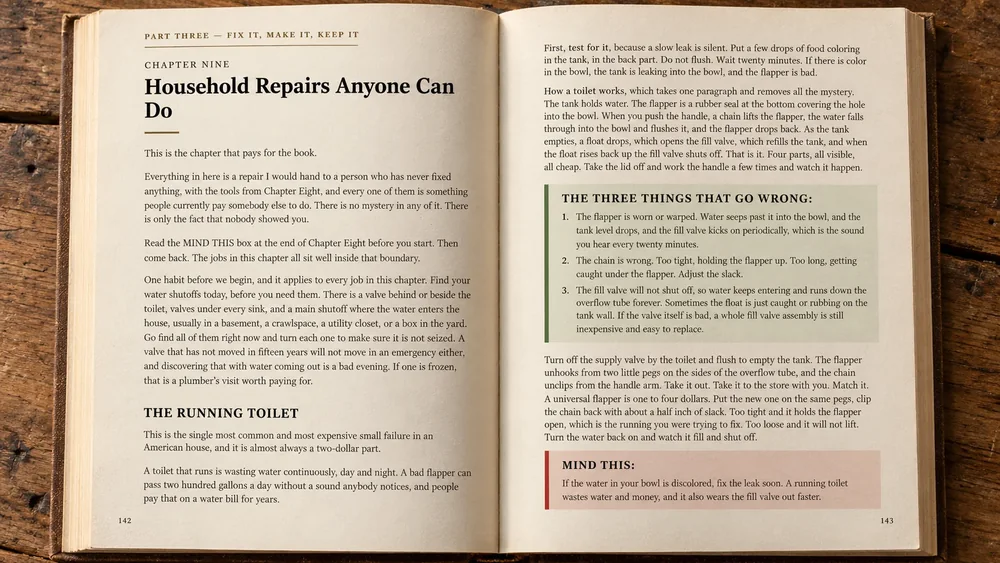
Thirteen-point type, generous leading, sixty-odd characters a line, warm off-white paper. Laid out for a reader over fifty holding it at arm's length in poor kitchen light.

A two-page spread from inside the manual, showing a chapter opening beside a page carrying a cost-comparison box.

The safety sections are not casual

A few topics here can hurt somebody if they are handled loosely, so they are treated as fixed rules rather than voice.

Low-acid foods must be pressure canned, and there is no safe boiling-water process for them. The book says so, says why, and sends you to the free tested USDA tables rather than printing times that go stale. It refuses to teach mushrooms from a page. It prints no ginseng harvest dates, because they differ by state and change, and points you at your own state agency. The remedies chapter is history and comfort, with a disclaimer and a list of signs that mean stop reading and go.

Fourteen Mind This boxes. None of them split across a page.

Mind This — Lye

Sodium hydroxide is a severe caustic. It is not like a strong cleaner. It destroys tissue on contact, and it does not hurt at first, which is how people get badly injured.

Always add lye to water, never water to lye. Water poured onto dry lye can erupt violently and spray caustic solution. The old reminder is: snow floats on the lake.

Chapter Eleven · one of fourteen

No. 05
The readers

What folks have written in.

★★★★★

“Did the subscription audit on a Sunday and found eighty-one dollars a month I had forgotten I was paying. The book cost $39.95. I have not even reached the canning chapter.”

Marlene Whitaker · Chillicothe, Ohio
★★★★★

“The sharpening chapter. That is the whole review. I did every knife in the drawer and cooking stopped being a fight. My daughter thought I had bought new ones.”

Ray Puckett · Johnson City, Tennessee
★★★★★

“I rent, so I assumed half of this would not apply. The candle draft walk took twenty minutes and the rope caulk came out when I moved. Power bill down about forty a month all winter.”

Dana Shelton · Hazard, Kentucky
No. 06
Who is talking

Arlie, of Rockhouse Creek.

The house I grew up in had four rooms and no bathroom until I was near grown. We carried water from a spring in two galvanized buckets, and in January somebody had to break the ice with the back of an axe.

I say that not for sympathy. I say it because a person who has lived without a thing knows exactly what that thing is worth, and that is a kind of arithmetic most people never get to learn.

My grandmother was the one folks fetched when somebody took sick. My grandfather kept about a dozen hand tools, every one of them sharp, and he finished everything he ever started. Most everybody left this creek. We stayed because it was ours, and because a place you know all the way down is cheaper to live in than a place you do not.

I have two grandchildren, Hollis and June, and neither one knew how to patch a pair of jeans. That is not a complaint about them. It is a complaint about my generation. We quit teaching it, slowly and for understandable reasons, and now the bills have come back up the holler.

I am sixty-eight. I am not going to be teaching these children much longer. So here it is, written down.

Arlie seated on the porch steps at Rockhouse Creek at golden hour, a whetstone in his hand, canning jars and split firewood behind him.
No. 07
The order

$39.95 once. Yours forever.

Nobody can sell you a subscription to knowing how to sharpen your own knife. Once you know it, it is yours, and the knowing does not expire. That is the book, and it is the pricing too.

The manual displayed on a tablet beside a printed copy on a kitchen counter.
The complete manual Launch price ends Sunday
$47$39.95One payment · no subscription
  • 269-page illustrated PDF, A4, print-ready
  • Reads on a phone, tablet, computer, or paper
  • Instant download by email
  • No upsell, no course afterwards
  • Free updates to this edition
Get the manual · $39.95
7 day
refund

If it is not worth $39.95, tell me.

Seven days, no questions, no form. Write to contact@arliecaudill.com and I will send the money back. I would rather you keep your $39.95 than feel sold to. That would make this book a liar.

No. 08
Questions

What folks ask before they buy.

I rent an apartment. Is most of this useless to me?

About three quarters works as written in a rented apartment with a window. The garden chapter starts with a five-gallon bucket on a step, not a tiller. The draft chapter is weighted toward rope caulk, window film, outlet gaskets and curtains — all of which come out when you leave. Where a chapter needs you to own the place, it says so.

Do I need to be handy?

No. Chapter Eight begins with the habit of mind rather than the tools, and the first repairs are the ones where the downside is nothing: a wobbly chair, a sticking drawer, a running toilet. The book is also plain about what to hire out — gas, the electrical panel, anything structural, anything under tension — and says it three separate times.

Do I have to move to the country?

No. The book's own front matter says it is not a survival manual, not a poverty story, and not anti-modern. I keep a refrigerator, a chest freezer and a pressure canner and would fight you over all three. The test is never old or new. It is what a thing costs you over ten years and whether you can keep it running.

How quickly would I see anything?

The kitchen pays back the same week; a pot of beans saves you money on Tuesday. The subscription audit pays back the same afternoon. Draft sealing turns up in a power bill a month or two later. Mending and the garden are next-season money. The thirty-day plan is ordered so the fast ones come first.

Is the canning advice actually safe?

Every canning section follows current USDA and National Center for Home Food Preservation guidance. Low-acid foods must be pressure canned and the book states there is no safe boiling-water process for them. Electric multicookers are not endorsed for low-acid canning. Where my grandmother's method is no longer considered safe — open-kettle canning — it says so and says why. And it sends you to the free tested tables for your own altitude rather than printing times that go out of date.

What format is it, and can I print it?

One PDF. A4, 269 pages, thirteen-point type with generous leading because a good share of readers are over fifty. It prints cleanly in black and white — the colour in the boxes is decoration, and every box is labelled in words, so a greyscale print loses nothing.

Will this fix my budget?

Honestly, not on its own, and the book refuses to pretend otherwise. If the rent is more than the wages, a ledger is a record of a squeeze and not a way out of it; the answer there is wages or housing or help, not a sharper knife. What this gives you back is the part you have a hand on, which for most households is a few thousand dollars a year.

One last thing

It was never hidden from you.

There was no secret and no lost wisdom. It was ordinary, and it was done in broad daylight on front porches by people who would have been glad to show you. Then one generation got busy and did not pass it along. That is all that happened — and the fix is that somebody has to hand it to you now.

Get the manual · $39.95

Visa · Mastercard · Amex · PayPal · Apple Pay · 7-day refund

$47$39.95
Get the manual